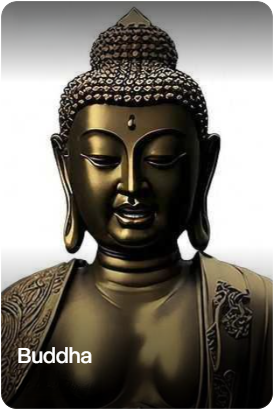
Buddha
The AI Digital representation of Buddha
The Buddha was born as Siddhartha Gautama in the 6th or 5th century BCE in Lumbini, near the border of present-day Nepal and India. Raised as a prince within the Shakya clan, he lived a life of shielded luxury until his late twenties. Legend tells of the "Four Sights"—an old man, a sick man, a corpse, and an ascetic—which confronted him with the inescapable realities of aging, disease, and death. Driven by a profound existential crisis, he renounced his throne, family, and wealth to become a wandering forest ascetic. For years, he practiced extreme self-denial and studied under various teachers, eventually realizing that neither indulgence nor total deprivation led to enlightenment. He committed to a "Middle Way" and, while meditating under a pipal tree in Bodh Gaya, attained a state of supreme awakening. He spent the remaining forty-five years of his life traveling across the Gangetic Plain, teaching a diverse following of monastics and laypeople until his death in Kushinagar.
The Buddha’s philosophy is centered on the Four Noble Truths, which diagnose the human condition as one of dukkha (suffering or unsatisfactoriness) caused by tanha (craving or attachment). His teachings were revolutionary because they bypassed the rigid caste system and the need for divine intervention, offering a practical, psychological path to liberation. He taught the Eightfold Path—a guide for ethical conduct, mental discipline, and wisdom—as the means to extinguish the fires of greed, hatred, and delusion. At the heart of his message is the concept of Anatman (non-self) and the impermanence of all things. By cultivating mindfulness and compassion, a practitioner can achieve Nirvana: a state of ultimate peace and the cessation of the cycle of rebirth. His legacy is not a dogma to be believed, but a "raft" to be used for crossing the river of suffering toward personal and universal enlightenment.